
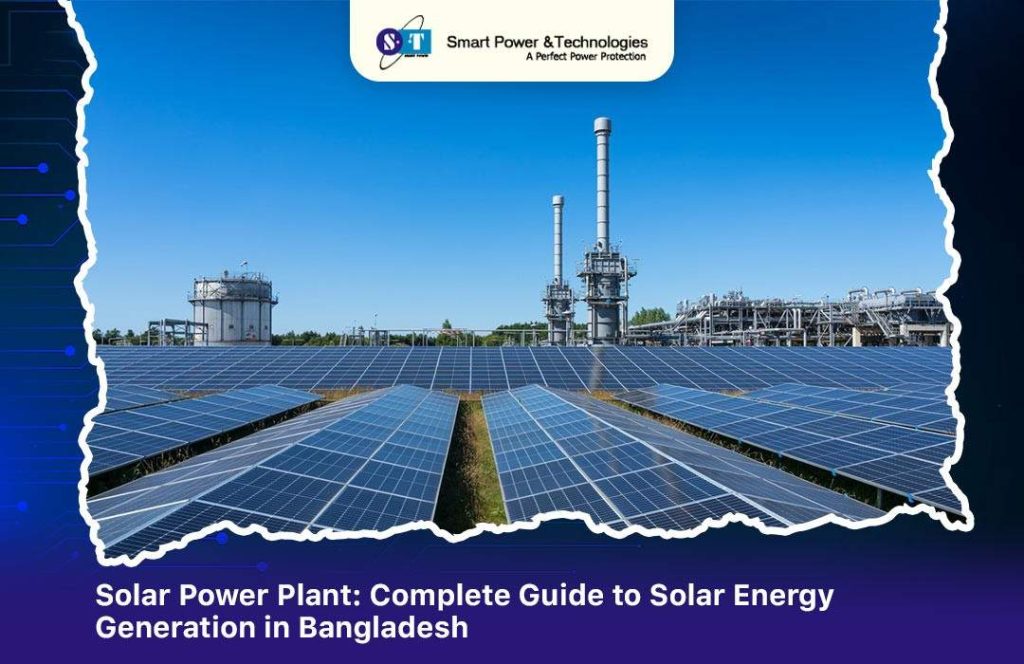
Bangladesh faces a serious energy problem. Electricity demand is rising fast. Grid outages hit businesses hard. And fuel prices keep climbing.
For factories, hospitals, and offices across Dhaka, Chattogram, and beyond, unreliable power is not just a hassle. It cuts into profit every single day.
That is why solar power plants are no longer just a “green” idea. They are a smart business move.
The numbers back this up. According to SREDA, Bangladesh’s total installed renewable capacity reached 1,690 MW in 2025, led by solar. BIDA projects the solar market will grow at a 38.6% compound annual rate through 2030, reaching 3.9 GW. Power demand is growing at 7% per year. Businesses that act now will stay ahead.
What Is a Solar Power Plant?
A solar power plant converts sunlight into usable electricity using photovoltaic (PV) panels or solar thermal technology. Systems range from small rooftop units to huge utility-scale farms generating hundreds of megawatts.
Featured Snippet Definition: A solar power plant converts sunlight into electricity using solar panels or solar thermal collectors. It serves homes, businesses, factories, and grids at scales from a few kilowatts to hundreds of megawatts.
How Solar Energy Is Converted Into Electricity
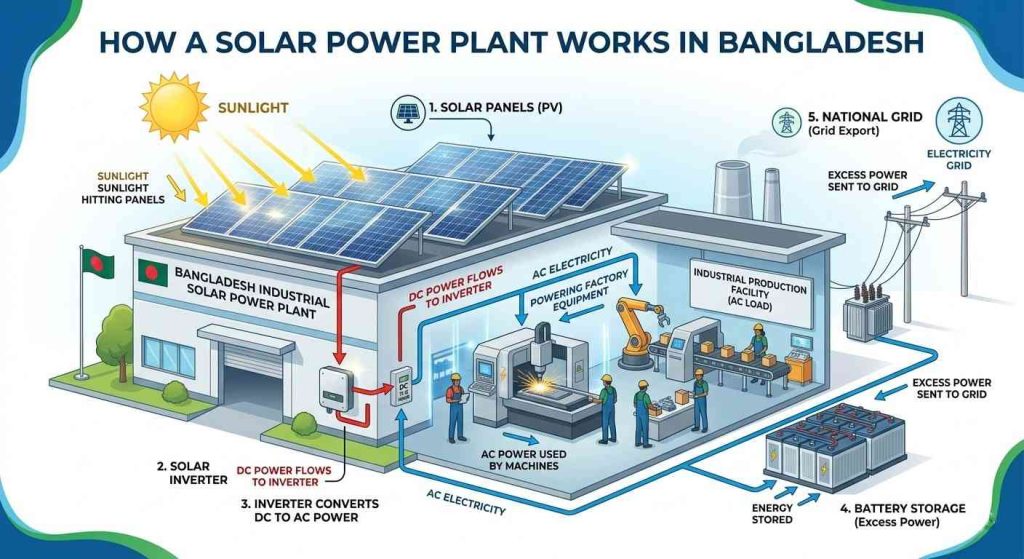
When sunlight hits a solar panel, photons knock electrons loose from silicon cells. That creates direct current (DC) electricity. A solar inverter converts DC into alternating current (AC) the type your machines, lights, and grid all use. The process is clean, silent, and needs no fuel.
Bangladesh’s Renewable Energy Goals
Bangladesh wants 20% of electricity from renewables by 2030 and 30% by 2040. Solar leads this push. The Renewable Energy Policy 2025 sets these targets and directs SREDA to support rooftop solar for industries, especially the RMG sector. BPDB has also floated tenders for 52 solar power plants targeting 5,200 MW of capacity. For businesses, investing in solar now aligns with national policy and real financial gains.
How Does a Solar Power Plant Work?
Bangladesh receives an average of 5 kWh of solar irradiance per square meter per day one of Asia’s better solar locations. Here is the step-by-step process:
Featured Snippet: Step-by-Step Solar Power Generation
- Sunlight strikes solar panels
- PV cells convert light into DC electricity
- DC flows to the solar inverter
- Inverter converts DC to AC electricity
- AC powers connected loads (machines, lights, HVAC)
- Surplus energy goes to battery storage or the grid
- A monitoring system tracks generation in real time
For grid-tied systems, net metering earns you credits for surplus power. For sites with frequent outages, battery storage gives near-uninterrupted supply. Explore our Power Backup Solutions
Main Components of a Solar Power Plant
A solar plant has several key parts working together.
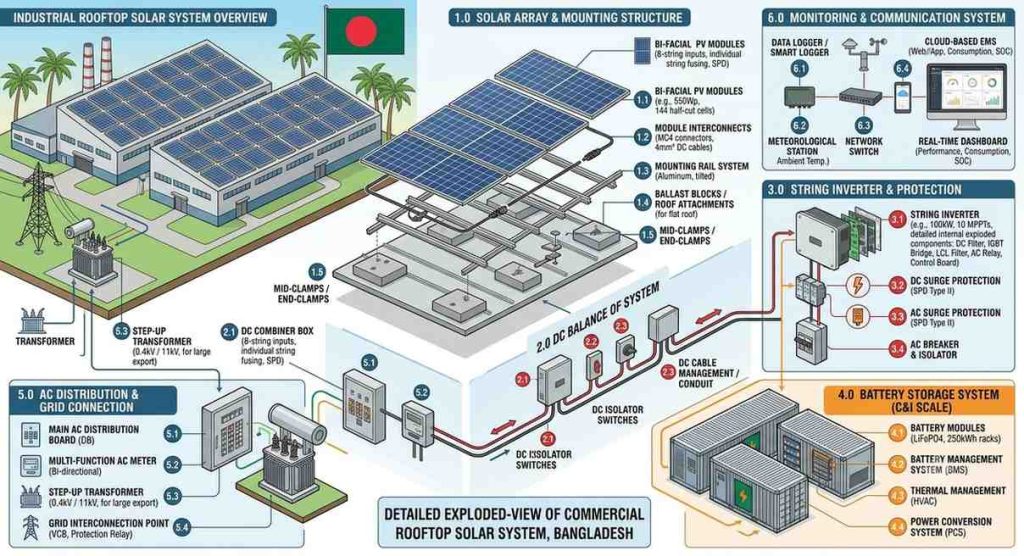
Solar Panels (PV Modules) The core energy-harvesting units. Commercial panels today rate 400W to 700W each, with 18–23% efficiency.
Solar Inverters Convert DC to AC and manage system performance. Central inverters suit large plants. String inverters fit medium commercial systems. Microinverters handle individual panels where shading is an issue.
Mounting Structures Galvanised steel or aluminium frames hold panels at the right angle. In Bangladesh, a 20–25 degree south-facing tilt maximises annual output.
Battery Storage Lithium iron phosphate (LiFePO4) batteries store energy for nights and outages. Battery energy storage systems (BESS) can provide hours of industrial backup.
Transformers and Substations Large industrial plants use step-up transformers and substations for grid connection. Smart Power Ltd. delivers these as part of integrated EPC projects.
Monitoring Systems SCADA and smart dashboards track live output, flag faults, and optimise performance from any device.
Protection and Cabling Combiner boxes, surge protectors, and proper DC/AC cabling prevent faults, overheating, and fire risk. All wiring must meet Bangladesh Electricity Code and IEC standards.
Types of Solar Power Plants
Utility-Scale 1 MW or more, connected to the national grid. BPDB is actively developing this category with its 52-plant, 5,200 MW tender programme.
Commercial and Industrial 50 kW to several MW for factories, offices, and large institutions. This is the most relevant type for most businesses in Bangladesh. Explore Industrial Solar Systems
Rooftop Solar Uses existing roof space. Ideal for factories, warehouses, hospitals, and schools. The most common type for commercial use in Bangladesh.
Ground-Mounted Built on open land for larger capacities where rooftop space is limited.
Floating Solar Panels installed on water bodies. Several pilot projects are now running in Bangladesh, with strong results for a water-rich country.
Hybrid Systems Combine solar with batteries, diesel generators, or the grid for maximum reliability.
- Solar + Battery Best for sites needing continuous backup.
- Solar + Grid-Tied Solar as primary power, grid as backup. Net metering exports surplus energy. Most popular for commercial sites with stable grid access.
- Solar + Diesel Solar handles the daytime base load. Diesel runs only when needed. Cuts fuel use by 60–80%. Explore Diesel Generator Solutions
- Off-Grid Fully independent of the national grid. Suited for remote locations and telecom towers.
Solar Power Plant Capacity and Sizing
Understanding system size helps you choose the right plant.
- 1 kW = 1,000 watts | 1 MW = 1,000 kW | 1 GW = 1,000 MW
- A 100 kW system generates roughly 400–500 kWh per day in Bangladesh
Sizing Formula: Capacity (kW) = Daily Energy Use (kWh) ÷ Peak Sun Hours × Safety Factor (1.2–1.3)
Common system sizes for businesses:
- 10 kW Small offices, clinics, shops. Covers basic loads.
- 50 kW Medium buildings, schools, small factories.
- 100 kW Medium factories, hospitals, large offices. Needs 800–1,000 sq. meters of roof.
- 500 kW Large manufacturing facilities and commercial parks.
- 1 MW+ Major plants and industrial zones. Needs full EPC planning and grid connection approval.
Quick Sizing Checklist:
- Calculate total daily energy use (kWh)
- Identify peak power demand (kW)
- Check available roof or land area
- Add a 15–20% future expansion buffer
- Confirm roof load capacity for rooftop systems
- Verify grid connection requirements
An energy audit gives you the most accurate data for sizing. Smart Power Ltd. offers professional energy audit services for industrial and commercial clients.
Benefits of Installing a Solar Power Plant
Cut Electricity Bills As of September 2025, the average business electricity rate in Bangladesh is BDT 12.39 per kWh, following BERC’s 5% tariff hike in June 2024. Solar generates free electricity during the day. A 100 kW system can save BDT 15–25 lakh per year.
Cut Carbon Emissions In 2024, global solar generation avoided 1,658 million tonnes of CO2 equivalent to the entire US power sector’s emissions, according to Ember’s Global Electricity Review 2025. At the project level, a 100 kW plant in Bangladesh prevents roughly 80–120 tonnes of CO2 per year.
Energy Independence Solar plus battery storage frees your business from load shedding, voltage swings, and grid uncertainty.
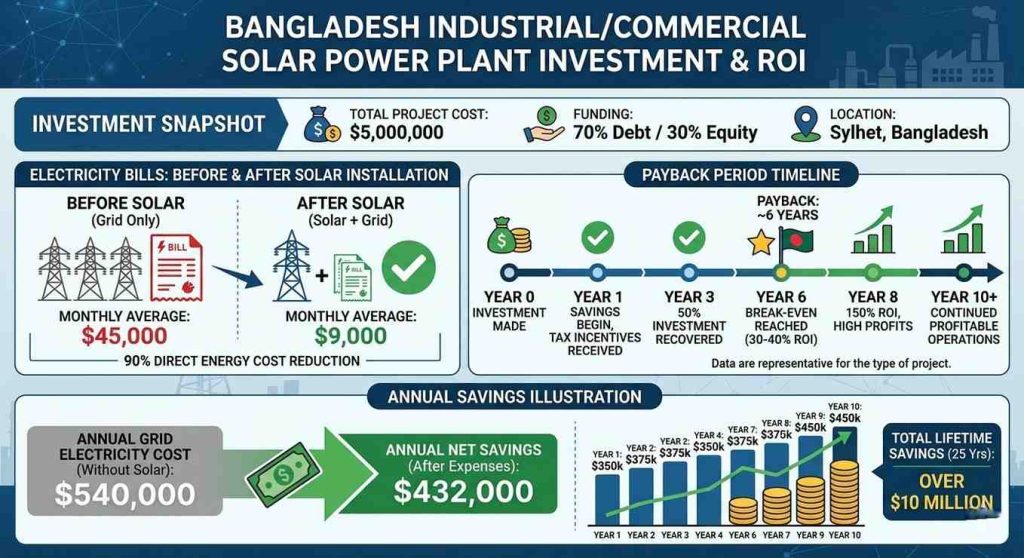
Strong ROI Most commercial projects in Bangladesh pay back in 4–6 years. After that, the system generates near-free power for 20+ more years.
Government Incentives The Renewable Energy Policy 2025 reinforces tax holidays, VAT exemptions on solar equipment, and net metering support. IDCOL also provides project financing.
Meet Sustainability Goals International buyers now require ESG proof. Solar supports factory audits, green building certifications, and export compliance.
Solar Power Plant vs Diesel Generator vs UPS vs IPS
Factor | Solar Power Plant | Diesel Generator | UPS | IPS |
Purpose | Generate electricity | Backup power | Protect critical equipment | Basic home/office backup |
Operating Cost | Very low | High (fuel required) | Moderate | Moderate |
Backup Duration | Hours to days (with batteries) | As long as fuel is available | 10–30 minutes | Several hours |
Scale | 3 kW to multi-MW | Small to large | Equipment-specific | Usually 1–5 kVA |
Maintenance | Low | High | Moderate | Moderate |
ROI | Pays back in 4–7 years | No long-term savings | No direct ROI | No direct ROI |
Best For | Factories, hospitals, businesses | Extended backup power | Servers, computers, critical systems | Homes and small offices |
Solar Power Plant Applications Across Industries
Solar works across every major sector in Bangladesh.
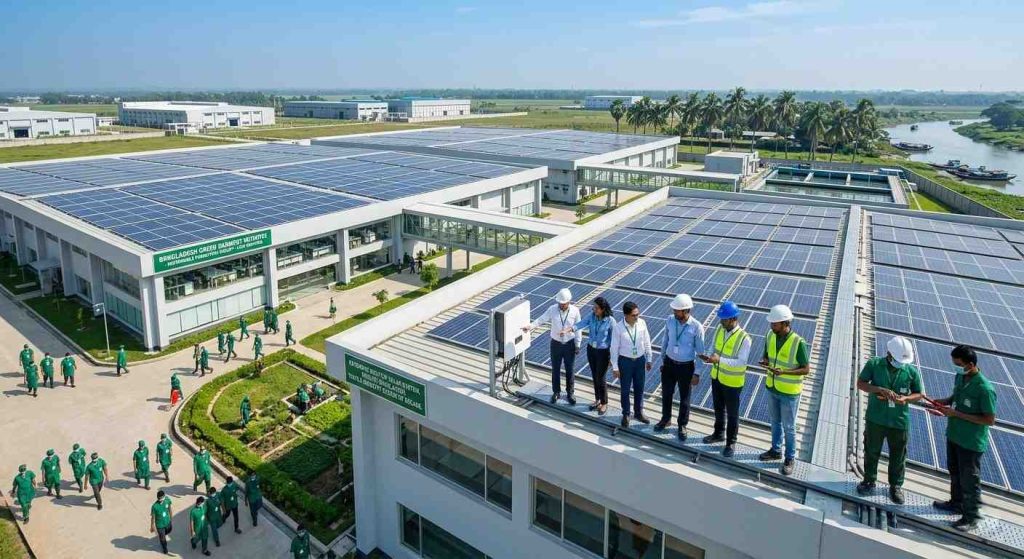
Garment and Textile Factories Bangladesh’s RMG sector generates over 80% of the country’s export earnings and has pledged to cut 30% of greenhouse gas emissions by 2030. The country now hosts 270 LEED-certified garment factories a world record after adding a historic 38 new certifications in 2025. Bangladesh also holds 68 of the world’s top 100 highest-rated LEED factories. Solar is a core requirement for LEED Platinum and Gold ratings. Explore Industrial Solar Power Systems
Hospitals Continuous power with battery backup. Solar cuts a major share of operating costs.
Manufacturing Plants High daytime energy use makes solar highly cost-effective for production facilities.
Commercial Buildings Large flat roofs on offices, malls, and warehouses are a natural fit for rooftop solar.
Agriculture and Telecom Off-grid or hybrid solar powers irrigation pumps and remote mobile towers without fuel.
Solar Power Plant Cost in Bangladesh
Costs vary by system size, type, and equipment brand. As a general guide:
- Equipment BDT 70,000–120,000 per kW installed (60–70% of total cost)
- Installation 15–20% of project cost
- Battery storage BDT 40,000–100,000 per kWh added. IEA confirmed battery storage is now the world’s fastest-growing power technology, with 108 GW of new capacity deployed in 2025 a 40% increase over 2024
- Annual O&M 0.5–1.5% of system cost
Payback Example: A BDT 1 crore system saving BDT 20 lakh per year pays back in 5 years. After that, 20+ years of near-free electricity.
Financing options include direct purchase, bank green finance, IDCOL programmes, Power Purchase Agreements (PPAs), and solar leasing. Contact us for a Solar Consultation
Installation Process and Regulations
Solar Installation in 8 Steps:
- Site Assessment Roof or land area, shading, structural capacity, grid access
- Solar Feasibility Study Energy yield, cost-benefit, payback analysis
- Energy Audit and Load Analysis Identify all loads and peak demand
- System Design and Engineering Full plant design per IEC standards
- Equipment Selection Certified panels, inverters, batteries, protection devices
- Installation and Commissioning Mounting, wiring, inverter, earthing, monitoring
- Testing and Verification IV curve tracing, insulation testing, performance checks
- Grid Connection and Handover Approval from BPDB/DESCO/DPDC/NESCO, net metering application, documentation
Explore our Electrical Infrastructure Services
Regulations: Bangladesh’s Renewable Energy Policy 2025 sets the national framework. SREDA serves as the nodal agency for all grid-connected and off-grid projects. Grid-tied systems need interconnection approval and net metering application from your local distributor. Smart Power Ltd. manages all permits and approvals as part of our EPC service.
Why Businesses in Bangladesh Are Investing in Solar Now
- Business electricity tariffs hit BDT 12.39/kWh in September 2025 and are projected to keep rising
- The EU Bangladesh’s largest apparel buyer recorded USD 1.68 billion in purchases in August 2024 and now requires EU Green Deal compliance from suppliers
- Bangladesh added a record 38 LEED factory certifications in 2025, bringing its world-leading total to 270
- IEA confirmed global solar capacity reached 2.2 TW in 2024, after a 30% year-on-year jump in new installations equipment costs are now at record lows
- ESG compliance, grid instability, and export market pressure are making solar a strategic necessity, not just a cost-saving play
Why Choose Smart Power Ltd. for Solar Power Plant Solutions
Smart Power Ltd. brings over 15 years of hands-on experience in industrial power systems, solar energy, and electrical infrastructure across Bangladesh. We work with factories, hospitals, commercial facilities, and institutions of all sizes.
We deliver complete EPC services from feasibility study and system design through procurement, installation, commissioning, and handover. One partner for the whole project.
We source only certified equipment from global manufacturers with proven tropical climate performance. Our technical teams provide professional installation and ongoing maintenance support to keep your plant running at peak performance for decades.
From diesel generators and UPS systems to transformer solutions and commercial solar, Smart Power Ltd. is your trusted partner for reliable, efficient, and sustainable energy in Bangladesh.
Request a Free Solar Consultation | Explore Solar Solutions | Contact Smart Power Ltd.
Frequently Asked Questions (FAQ)
A system that converts sunlight into electricity using photovoltaic panels. It ranges from small rooftop units to large industrial plants generating hundreds of kilowatts or megawatts of clean electricity.
Commercial and industrial systems generally cost BDT 70,000–120,000 per kW installed. A 100 kW system may cost BDT 70–120 lakh. Contact Smart Power Ltd. for a detailed quote.
Quality solar panels last 25–30 years. Inverters typically need replacing after 10–15 years. With proper maintenance, the overall plant delivers reliable generation for 25+ years.
A grid-tied system without battery storage shuts down during outages for safety. A solar + battery or hybrid solar + generator system keeps running. For businesses needing backup, a hybrid system is the right choice.
Yes. SREDA’s net metering policy lets commercial and industrial users export surplus electricity to the grid and receive bill credits. Applications go through BPDB, DESCO, DPDC, or NESCO.
Conclusion
Solar power plants are no longer just a renewable energy option they are a smart investment for businesses in Bangladesh. With rising electricity costs, increasing sustainability requirements, and attractive long-term savings, solar offers a reliable path to lower energy expenses and greater energy independence. By choosing the right system and an experienced EPC partner, businesses can secure clean, cost-effective power for decades while supporting Bangladesh’s renewable energy future.