
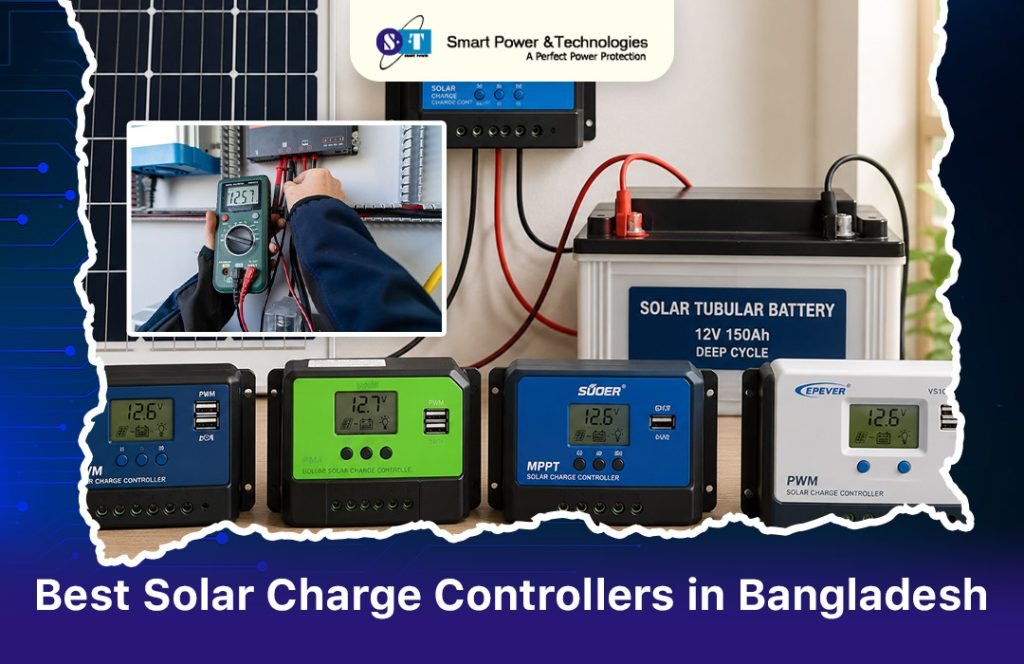
As solar power adoption continues to grow across Bangladesh, more homeowners and businesses are investing in solar panels, batteries, and inverters to reduce electricity costs and stay protected from frequent grid outages. One component that is often overlooked, but is absolutely essential to a well-functioning solar system, is the solar charge controller. Choosing the wrong charge controller, or skipping one altogether, can significantly reduce the efficiency and lifespan of your entire solar setup.
This guide explains what a solar charge controller does, the different types available, and how to choose the best one for your system in Bangladesh, with guidance from Smart Power LTD.
What Is a Solar Charge Controller
A solar charge controller is a device placed between your solar panels and your battery bank. Its primary job is to regulate the voltage and current coming from the solar panels before it reaches the battery, preventing overcharging and protecting the battery from damage. Without a charge controller, the fluctuating voltage produced by solar panels could overcharge batteries, significantly shortening their lifespan or causing safety hazards.
Why a Solar Charge Controller Is Essential
Solar panels do not produce a constant, steady voltage. Output varies constantly based on sunlight intensity, temperature, and time of day. If this unregulated power were sent directly to a battery, it would lead to overcharging, excessive heat buildup, and reduced battery life. A solar charge controller manages this process, ensuring your battery receives a safe and consistent charge, which in turn extends the life of your entire solar power system. This is especially important for solar battery systems, where protecting your investment in expensive batteries is a top priority.
Types of Solar Charge Controllers
There are two main types of solar charge controllers available on the market, each with its own advantages depending on your system size and budget.
PWM Charge Controllers
PWM, or Pulse Width Modulation, charge controllers are the more basic and affordable option. They work by directly connecting the solar panel to the battery and adjusting the connection on and off rapidly to control the charging rate. PWM controllers are simple, reliable, and cost-effective, making them a good choice for smaller solar systems where the panel and battery voltages are closely matched.
The main limitation of PWM controllers is that they are less efficient at converting solar power, especially when there is a larger difference between the panel’s voltage output and the battery’s voltage requirement. This means some potential energy from the panels is wasted rather than being used to charge the battery.
MPPT Charge Controllers
MPPT, or Maximum Power Point Tracking, charge controllers are a more advanced and efficient option. They constantly monitor the solar panel’s output and adjust the electrical operating point to extract the maximum possible power at any given moment, converting excess voltage into additional charging current rather than wasting it.
MPPT controllers are significantly more efficient than PWM controllers, often improving energy harvest by twenty to thirty percent, particularly in systems where panel voltage is notably higher than battery voltage, or in colder and variable weather conditions. While MPPT controllers cost more upfront, the improved efficiency often makes them the better long-term investment, especially for larger solar systems or systems where maximizing every bit of available sunlight matters.
PWM vs MPPT: Which Should You Choose
The right choice between PWM and MPPT depends largely on your system size, budget, and specific setup. For small residential systems with a single solar panel closely matched to battery voltage, a PWM controller may be sufficient and more budget-friendly. For larger systems, systems with multiple panels wired in series, or situations where maximizing energy efficiency is a priority, an MPPT controller is generally the better investment despite the higher upfront cost.
Key Features to Look for in a Solar Charge Controller
When choosing a solar charge controller in Bangladesh, it is important to look beyond just the price. Consider the controller’s rated current capacity, measured in amps, which must match or exceed your solar panel array’s output to avoid damage. Check the voltage compatibility to ensure the controller works with your specific battery type and system voltage, whether 12V, 24V, or 48V. Look for built-in protection features such as overcharge protection, over-discharge protection, short circuit protection, and temperature compensation, which help extend battery life and improve system safety. A digital display or app connectivity is also a valuable feature, allowing you to monitor system performance, battery status, and charging data in real time.
How Solar Charge Controllers Fit Into a Complete Solar System
A solar charge controller does not work in isolation. It is one part of a broader solar power setup that typically includes solar panels, batteries, an inverter, and supporting wiring and safety components. Smart Power LTD offers comprehensive solar power plant installations in Bangladesh, helping customers select and integrate the right combination of components, including charge controllers, for their specific power needs. For those looking to combine solar power with backup UPS protection, our guide on connecting solar panels with UPS systems is also a useful resource.
Choosing the Right System Voltage
Solar charge controllers are typically available for 12V, 24V, and 48V systems. Higher voltage systems, such as 48V setups, are increasingly popular for larger solar installations because they allow for thinner wiring, reduced energy loss, and easier system expansion in the future. You can learn more about the benefits of higher voltage systems in our guide on why a 48V inverter is often a smarter choice for modern solar and backup power needs.
Maintaining Your Solar Charge Controller and System
Like any electrical component, solar charge controllers and the broader solar system benefit from regular inspection and maintenance to ensure long-term performance. Dust accumulation on panels, loose wiring connections, and outdated firmware on smart controllers can all affect efficiency over time. Smart Power LTD offers professional solar power plant maintenance services to help keep your entire system, including your charge controller, running at peak performance.
Why Choose Smart Power LTD for Your Solar Power Needs
With more than 20 years of experience and in-house manufacturing capabilities, Smart Power LTD is a trusted supplier of solar power components, batteries, inverters, and related electrical equipment across Bangladesh. Our team helps customers select the right combination of components for their specific budget, system size, and power goals, rather than pushing a one-size-fits-all solution. You can explore our full range of offerings on the Our Services page and learn more about our background on the Profile page.
Get Expert Guidance on Choosing a Solar Charge Controller
Selecting the right solar charge controller is a small but critical decision that directly affects the efficiency, safety, and lifespan of your entire solar power system. Whether you are setting up a small home solar system or a larger installation for your business, getting professional guidance ensures you choose a controller that matches your actual needs rather than guessing based on price alone.
Contact Smart Power LTD today to speak with our team and get a free quote on solar charge controllers and complete solar power solutions tailored to your requirements in Bangladesh.