
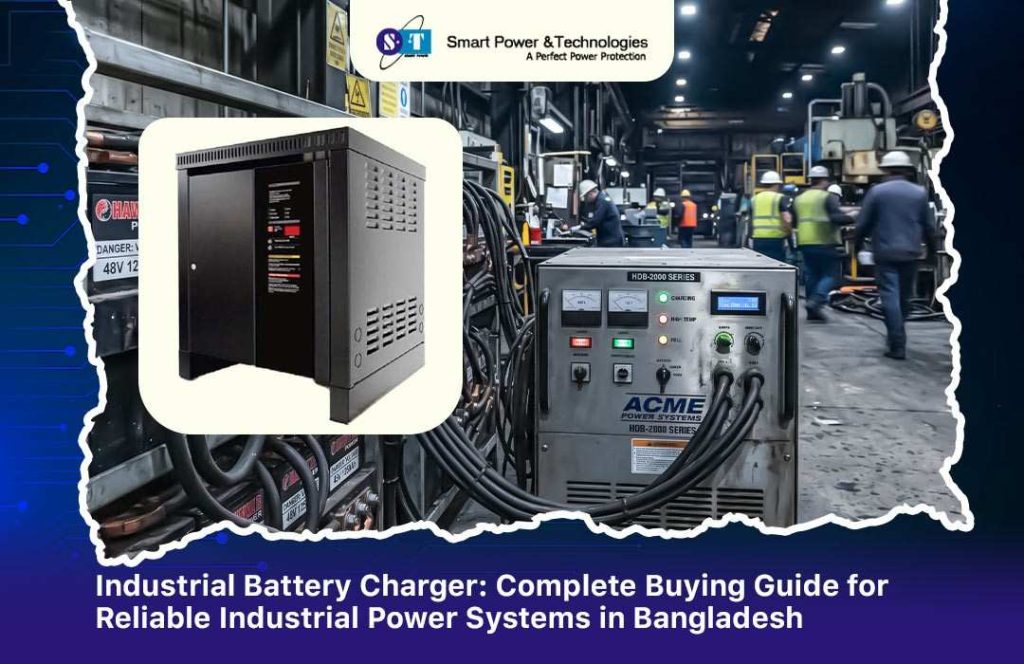
Power cuts cost money. Every minute of factory downtime hurts production, workers, and profits.
The problem often starts silently with the battery. A weak or poorly charged battery fails without warning. Then, when backup power should kick in, it doesn’t.
In 2025, Bangladesh’s power supply shortfall occasionally exceeded 500MW during peak hours, with a severe load-shedding event of up to 2,353MW recorded on 26 April 2025. For factories, telecom towers, hospitals, and substations across Dhaka, Chattogram, and Gazipur, this is not just a statistic. It is a daily operational risk. IEEFA
This is exactly why an industrial battery charger is not optional. It is essential.
An industrial battery charger keeps your backup system whether it’s a generator, a UPS, or a substation fully ready at all times.
In this guide, you will learn what an industrial battery charger is, how it works, which type suits your facility, how to choose the right size, what it costs in Bangladesh, and how Smart Power Ltd. can help.
What Is an Industrial Battery Charger?
Definition and Purpose
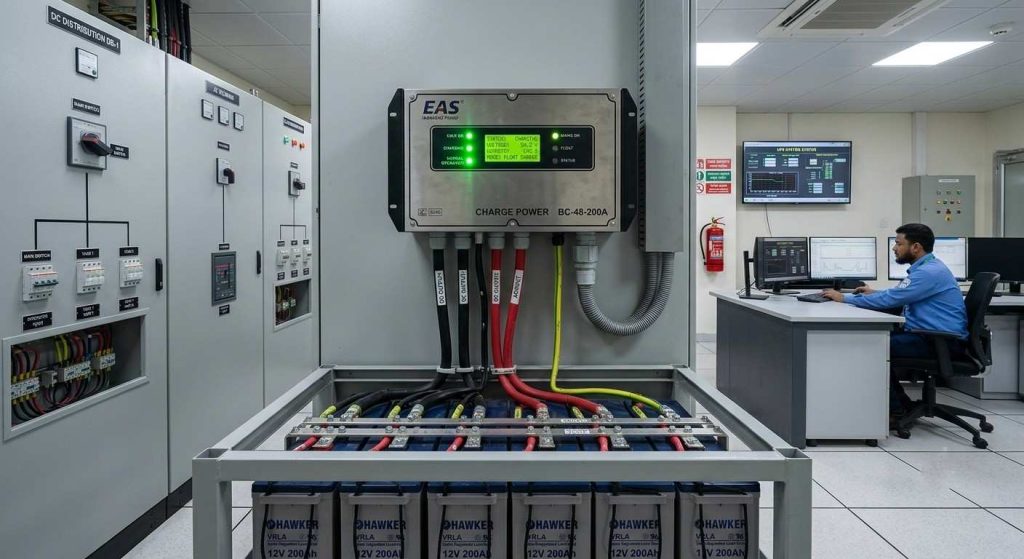
An industrial battery charger is a heavy-duty device. It takes AC power from the grid and converts it into regulated DC power. This DC power charges and maintains batteries used in industrial systems.
It is built for continuous operation, harsh conditions, and high reliability.
Featured Snippet Answer: An industrial battery charger converts AC mains power into regulated DC power to safely charge, maintain, and protect large batteries in generators, UPS systems, substations, and telecom towers. It keeps backup power systems ready at all times.
How It Differs from Standard Battery Chargers
A standard charger is built for light, occasional use like charging a car battery once a week.
An industrial charger is built for a completely different demand. It runs continuously. It handles large battery banks. It regulates voltage precisely. It protects against overcharging, overheating, and power surges.
The difference is like comparing a kitchen tap to an industrial water pump.
Role in Industrial Backup Power Systems
Your diesel generator needs a charged starter battery to start. Your online UPS needs a healthy battery bank to deliver backup power. Your substation needs a reliable DC supply for protection relays and control panels.
Without a proper industrial battery charger, all of these systems are at risk.
How Does an Industrial Battery Charger Work?
AC-to-DC Conversion Process
The charger takes alternating current (AC) from the mains. It converts this into direct current (DC). A rectifier circuit handles this conversion. Then a voltage regulation circuit keeps the output stable even when grid voltage fluctuates, which happens often in Bangladesh’s industrial zones.
Main Charging Stages
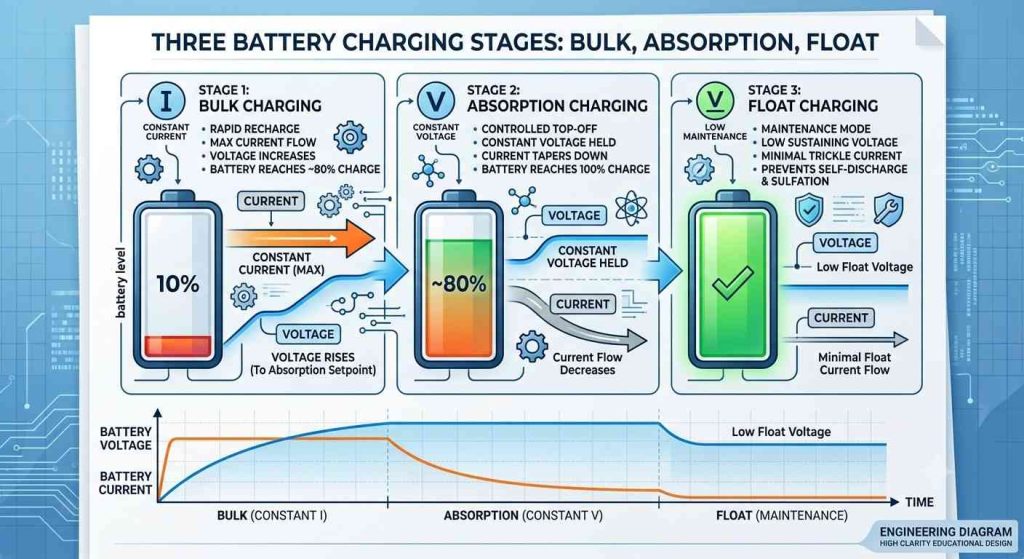
Industrial chargers use a multi-stage process. Each stage protects the battery and improves its lifespan.
Bulk Charging This is the first and fastest stage. The charger pushes maximum current into the battery. This brings it from empty to about 75–80% charge quickly.
Absorption Charging Once the battery hits a set voltage, the charger slows down. It holds voltage steady and reduces current gradually. This fills the remaining 20–25% safely.
Float Charging After a full charge, the charger switches to a gentle trickle. It keeps the battery at 100% without overcharging. This stage is critical for standby batteries the type used in most industrial backup systems across Bangladesh.
Automatic Monitoring and Protection Features
Modern industrial chargers watch the battery constantly. They monitor voltage, current, and temperature. If anything goes out of range, the charger adjusts or shuts down automatically. Your battery and equipment stay safe.
Key Components of an Industrial Battery Charger
Transformer and Rectifier
The transformer steps down incoming AC voltage. The rectifier converts it to DC. These two components handle the core power conversion work.
Voltage Regulation System
This system keeps the output voltage precise and stable. In areas with unstable power like industrial zones in Narayanganj, Tongi, and Karnaphuli this is not a luxury. It is a necessity. Smart Power Ltd. supplies industrial voltage stabilizers alongside charger systems for exactly this reason.
Control and Monitoring Unit
This unit manages all charging stages. It monitors battery health. It shows status through displays or indicator lights. Advanced models connect to SCADA systems for remote monitoring from your control room.
Protection Mechanisms
Good industrial chargers include overcharge protection, short-circuit protection, reverse polarity protection, overheat protection, and input surge protection. These features protect your battery and extend its working life.
Types of Industrial Battery Chargers
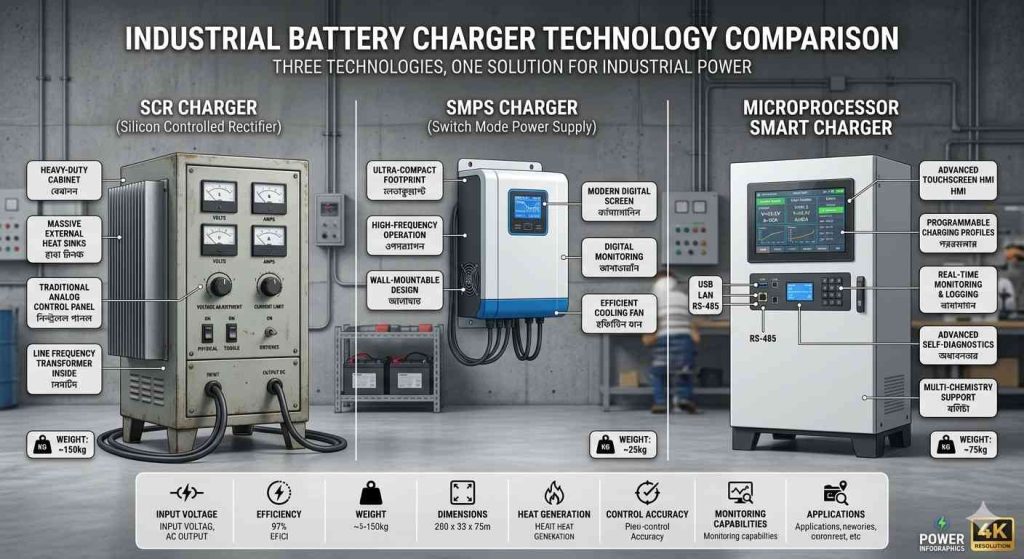
SCR-Based Chargers
SCR (Silicon Controlled Rectifier) chargers are traditional and proven. They are tough, cost-effective, and widely used in heavy industry. The downside is they are less efficient and generate more heat than newer technologies.
SMPS-Based Chargers
SMPS (Switched-Mode Power Supply) chargers are highly energy-efficient. They are compact, lightweight, and regulate voltage tightly. They respond faster to changes in battery condition. This makes them ideal for telecom towers and data centers.
Intelligent Microprocessor-Controlled Chargers
These are the most advanced option. A built-in microprocessor manages every aspect of charging in real time. It adapts to battery condition, temperature, and load. It offers remote monitoring, data logging, and predictive maintenance alerts.
Which Type Is Best for Industrial Applications?
Here is a quick comparison to help you decide.
SCR Chargers Best for tough industrial environments where ruggedness is the priority. Low upfront cost, higher long-term energy cost.
SMPS Chargers Best for telecom, data centers, and efficiency-focused facilities. Compact, efficient, and precise.
Microprocessor-Controlled Chargers Best for hospitals, substations, and large manufacturing plants where reliability and remote monitoring are critical.
After working with industrial clients across Dhaka and Chattogram, we consistently find that SMPS and intelligent chargers offer better long-term value despite their slightly higher purchase price.
Major Benefits of Industrial Battery Chargers
Improved Battery Life
Proper multi-stage charging prevents the two main battery killers: overcharging and undercharging. A quality industrial charger can significantly extend battery service life compared to basic charging methods.
Reduced Equipment Downtime
When your battery is always at full charge, your generator starts on the first try. Your UPS switches instantly. Costly downtime caused by flat batteries becomes a thing of the past.
Higher Operational Reliability
Bangladesh’s lead acid battery market was valued at $1.23 billion in 2024 and is projected to expand at a CAGR of 3%, reaching an estimated $1.8 billion by 2033. Much of this demand is driven by industrial backup power systems systems that depend on reliable charging to perform. A quality charger is what keeps them working. Data Insights Market
Lower Maintenance Costs
Properly charged batteries last longer and need fewer replacements. Over five years, the savings on battery replacements alone often cover the charger’s full cost.
Better Energy Efficiency
Modern SMPS chargers operate at over 90% efficiency. This cuts electricity consumption and reduces heat in your equipment room further extending the life of your batteries and connected systems.
Applications of Industrial Battery Chargers
Diesel Generator Systems
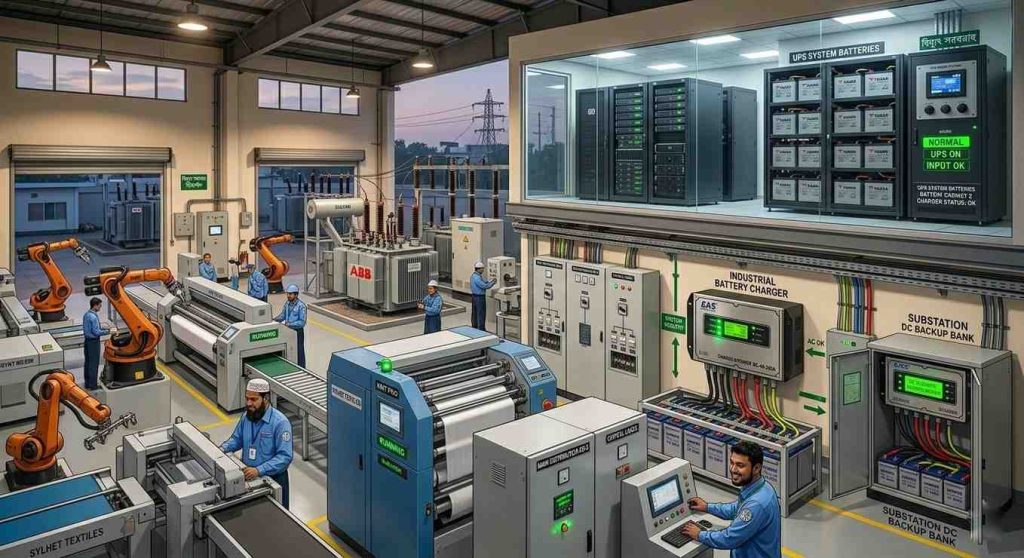
Every diesel generator has a starter battery. This battery must always be fully charged. Industrial chargers handle this continuously and automatically, so your generator is always ready to start. Smart Power Ltd. provides diesel generators bundled with complete charging solutions.
Industrial UPS Systems
Large UPS systems use substantial battery banks. Industrial chargers keep these banks at full capacity. This ensures seamless power continuity when the grid fails. Explore Smart Power Ltd.’s range of online UPS systems built for industrial demands.
Electrical Substations
Substations use battery-backed DC systems for protection relays, control panels, and communication equipment. These systems need precise, reliable charging around the clock. Smart Power Ltd. handles full substation solutions including HT switchgears and ATS panels.
Telecom Networks
The telecommunication sector is poised for significant growth in Bangladesh’s battery market, driven by the continuous expansion of mobile networks and the increasing need for uninterrupted connectivity. Mobile towers across Dhaka, Sylhet, and Chattogram rely on industrial battery chargers to stay live during outages. Marketreportanalytics
Manufacturing Facilities
Garment factories, steel plants, and food processing units use battery-backed equipment throughout their operations. A single production stop due to a flat battery can cost thousands of taka in lost output.
Data Centers and Hospitals
These facilities run 24/7 with zero tolerance for power failure. Industrial battery chargers are a core part of their UPS and emergency power systems and a key part of what Smart Power Ltd. installs across Bangladesh.
How to Choose the Right Industrial Battery Charger
Choosing the wrong charger is one of the most expensive mistakes in industrial power planning. We see it regularly a client buys on price alone and ends up replacing batteries twice as often.
Here is a practical, step-by-step approach.
Battery Type Compatibility
Different batteries need different charging profiles. Lead-acid, VRLA, AGM, Gel, and lithium-ion batteries all have different voltage and current requirements. Always confirm your charger supports your exact battery type before buying.
Voltage and Current Requirements
Match the charger output voltage to your battery bank. Common industrial voltages are 12V, 24V, 48V, 110V, and 220V DC. Current output must be enough to charge your battery in the required time without exceeding safe charging rates.
Charger Capacity Selection
A practical rule: the charger should deliver 10–20% of the battery’s Ah (Ampere-hour) capacity as charging current. For a 200Ah battery, choose a 20–40A charger. Too small means slow charging. Too large can damage the battery.
Environmental Conditions
For humid, dusty, or high-temperature environments common in factories across Gazipur and Karnaphuli choose chargers with IP-rated enclosures and built-in thermal management.
Safety and Compliance Standards
Look for chargers that meet IEC or equivalent international standards. Compliance means the equipment has been tested for safety and performance. This protects your facility and your team.
Industrial Battery Charger Selection Checklist
Featured Snippet Step-by-Step Buyer Guide:
- Identify your battery type (Lead-acid, VRLA, AGM, Gel, Lithium)
- Confirm battery bank voltage and total Ah capacity
- Calculate required charging current (10–20% of Ah rating)
- Check installation environment (temperature, humidity, dust)
- Decide on monitoring needs (local display or remote SCADA)
- Verify compliance with IEC safety standards
- Compare SCR, SMPS, and intelligent charger options
- Evaluate total cost of ownership not just purchase price
- Choose a supplier with local technical support in Bangladesh
- Request a consultation before finalising the specification
Need help working through this checklist? Contact Smart Power Ltd. for a free technical consultation.
Common Problems and Maintenance Tips
Overcharging and Undercharging Issues
Overcharging dries out battery electrolyte and corrodes the plates. Undercharging causes sulfation a buildup of lead sulfate crystals that permanently reduces battery capacity.
Field audits in 2025 showed that batteries in Bangladesh’s industrial sector had lifespans of only 2–3 years versus the rated 5 years, largely because of sub-optimal charge controllers. A quality multi-stage charger prevents both problems and helps you reach the full rated service life. Mordor Intelligence
Excessive Heat and Performance Loss
Heat damages both batteries and chargers. Poor ventilation, high ambient temperature, or running at excessive loads all cause overheating. Always install chargers in well-ventilated spaces. Keep ambient temperature within the manufacturer’s specified range.
Routine Inspection Checklist
Check battery terminals for corrosion monthly. Verify charger output voltage quarterly. Check float voltage settings annually. Inspect cable connections and housing every six months. Test protection systems including overcharge cutoff and short-circuit protection annually.
Best Practices for Longer Service Life
Keep chargers clean and dust-free. Never block ventilation panels. Replace worn cables immediately. Use a charger that matches your battery specification exactly. Always use qualified technicians for internal servicing.
Industrial Battery Charger Price Factors in Bangladesh
Capacity and Output Rating
Higher capacity chargers cost more. A small 10A charger costs far less than a 100A industrial model. Always size correctly oversizing wastes money, undersizing causes problems.
Technology and Features
SCR-based units are the most affordable. SMPS models cost moderately more. Intelligent microprocessor-controlled chargers with remote monitoring cost the most but deliver the highest long-term value.
Installation and Maintenance Costs
Factor in cabling, enclosure, installation labour, and commissioning. Budget for annual inspections, calibration, and firmware updates on smart charger systems.
Why Quality Matters More Than Initial Cost
We have seen businesses in Dhaka buy low-cost chargers and end up replacing batteries twice as often. Emergency repair costs and production losses during downtime far exceed the savings from the cheaper charger. A quality charger pays for itself. Talk to our team to get a realistic cost picture for your facility.
Why Industrial Businesses in Bangladesh Need Reliable Battery Chargers
Power Reliability Challenges
Bangladesh’s installed generation capacity stands at around 29,000 megawatts but recent production has not exceeded 14,000 megawatts, with demand at 14,000–15,000 megawatts, resulting in load shedding of 2,000 to 2,500 megawatts. For factories and commercial facilities, this gap means backup power is not a choice it is a survival requirement. Prothomalo
Industrial Growth and Backup Power Demand
The global industrial battery charger market reached USD 2,521.0 million in 2024, growing at a CAGR of 7.1% between 2021 and 2025. Bangladesh’s own industrial expansion across garments, pharmaceuticals, steel, and food processing is driving sharp local demand for reliable backup power equipment. Future Market Insights
Importance of Local Technical Support
Imported equipment without local support creates serious problems when issues arise. A supplier with an in-country technical team one that can respond quickly in Dhaka or Chattogram reduces your operational risk significantly. Smart Power Ltd. offers 24/7 after-sales support across Bangladesh.
Future Trends in Industrial Battery Charging
Smart charging with IoT connectivity is the next frontier. Remote monitoring, predictive maintenance alerts, and integration with solar power systems are already entering Bangladesh’s industrial sector. Businesses that upgrade now will be ahead of the curve.
Why Choose Smart Power Ltd. for Industrial Battery Charger Solutions?
Expertise in Industrial Power Systems
Smart Power Ltd. has deep, hands-on experience supplying and supporting industrial power equipment across Bangladesh from generator systems and UPS solutions to transformers and complete electrical infrastructure.
Customized Power Backup Solutions
Every facility is different. Smart Power Ltd. works directly with each client to specify chargers that match their exact battery bank, environment, and operational needs not generic off-the-shelf recommendations.
Technical Support and After-Sales Service
The team provides installation support, commissioning, routine maintenance, and emergency service. Fast local response when it matters most. Read more about how Smart Power Ltd. works and what sets the team apart.
Complete Industrial Power Infrastructure Solutions
Beyond battery chargers, Smart Power Ltd. offers diesel generators, industrial UPS systems, automatic transfer switches, distribution transformers, HT and LT switchgear panels, and solar power systems one trusted partner for your entire power infrastructure.
Ready to choose the right charger for your facility? Request a Free Technical Consultation from Smart Power Ltd.
Frequently Asked Questions
It charges and maintains batteries in generators, UPS systems, substations, telecom towers, and manufacturing equipment. It keeps backup power systems ready at all times.
They convert AC mains power into regulated DC power. They charge batteries through bulk, absorption, and float stages maximising charge efficiency and battery health.
Most support lead-acid, VRLA, AGM, and Gel batteries. Advanced models also support lithium-ion. Always confirm compatibility before buying.
Match output voltage to your battery bank. Set charging current at 10–20% of your battery’s Ah capacity. Factor in environment, monitoring needs, and compliance requirements.
Float charging is the final maintenance stage. The charger delivers a low, constant voltage to keep the battery at full charge without overcharging. It is essential for standby batteries used in most industrial backup systems.
Conclusion
Industrial battery chargers protect your batteries, reduce downtime, extend equipment life, and improve overall system reliability, while poor-quality or incorrectly selected chargers can lead to costly failures. The right charger always depends on your specific requirements, including battery type, voltage, capacity, operating environment, and monitoring needs, which is why proper selection is critical for long-term performance. Smart Power Ltd. supports industrial businesses across Bangladesh by helping them choose, install, and maintain the most suitable battery charging solutions, from single generator starter chargers to complete substation DC systems, ensuring dependable performance and expert technical guidance whenever needed. Contact Smart Power Ltd. today to request a technical consultation and get the right solution for your facility.